


Shri Mangueshi Temple
Lord Shiva as Shri Manguesh, family deity of Saraswat families, at Priol in Ponda, Goa
Mangeshi, Ponda, North Goa, Goa

Open daily 06:00–22:00 · Aarti at noon and 22:00
- Darshan
- -
- Dress code
- A dress code applies since 2011. Cover shoulders and knees; shorts and sleeveless tops are not allowed. Men should wear shirts and trousers or traditional attire, and women sarees, salwar kameez or other modest clothing.
- Best season
- -
About the temple
Shri Mangueshi Temple stands in Mangeshi village at Priol, in the Ponda taluka of North Goa. It is dedicated to Lord Shiva, worshipped here as Shri Manguesh, and is one of the largest and busiest temples in Goa. Many Saraswat Brahmin families honour Manguesh as their kuladevata, or family deity. The Shri Manguesh Saunsthan, a temple trust, runs the shrine, and the Swamiji of Shri Kavale Math is its spiritual head. The deity was first worshipped at Kushasthali, today's Cortalim, and was carried here in 1560 to keep it safe during Portuguese rule. The temple holds a special place in Goan art and literature, and the Mangeshkar family takes its surname from the deity. Guest lodgings called Agrashalas are part of the complex.
Significance
Temple tradition links the name Manguesh to a story of Shiva and Parvati. After losing a game of dice to Parvati, Shiva left Mount Kailash and settled in the forests of Kushasthali. When Parvati came looking for him, he appeared before her as a tiger. Frightened, she cried out "Trahi Mam Girisha", asking the Lord of the Mountains to save her, and he returned to his true form. The words "Mam Girisha" later became Manguesh. For Saraswat families the temple is the home of their family deity, and the Magha Poornima Jatra is its main yearly festival.
History
- 11510 CE · Portuguese rule begins in Goa
A period of persecution and destruction of Hindu temples followed in the region.
- 21560 CE · Deity moved to Priol
Devotees secretly carried the lingam from Kushasthali (Cortalim) to Priol, Ponda, then under Adil Shahi rule.
- 31739 · Peshwa land grant
The Peshwas gave Mangeshi village to the temple at the suggestion of devotee Ramchandra Malhar Sukhtankar.
- 41763 · Area under Portuguese control
The region passed to the Portuguese, but by then they were more tolerant and the temple was left untouched.
- 51890 CE · Third temple building
A new temple structure was built at the same site.
- 617 Feb 1973 · Golden kalasha installed
A fourth renovation ended on Magha Purnima with a golden kalasha placed over the shrine.
Architecture
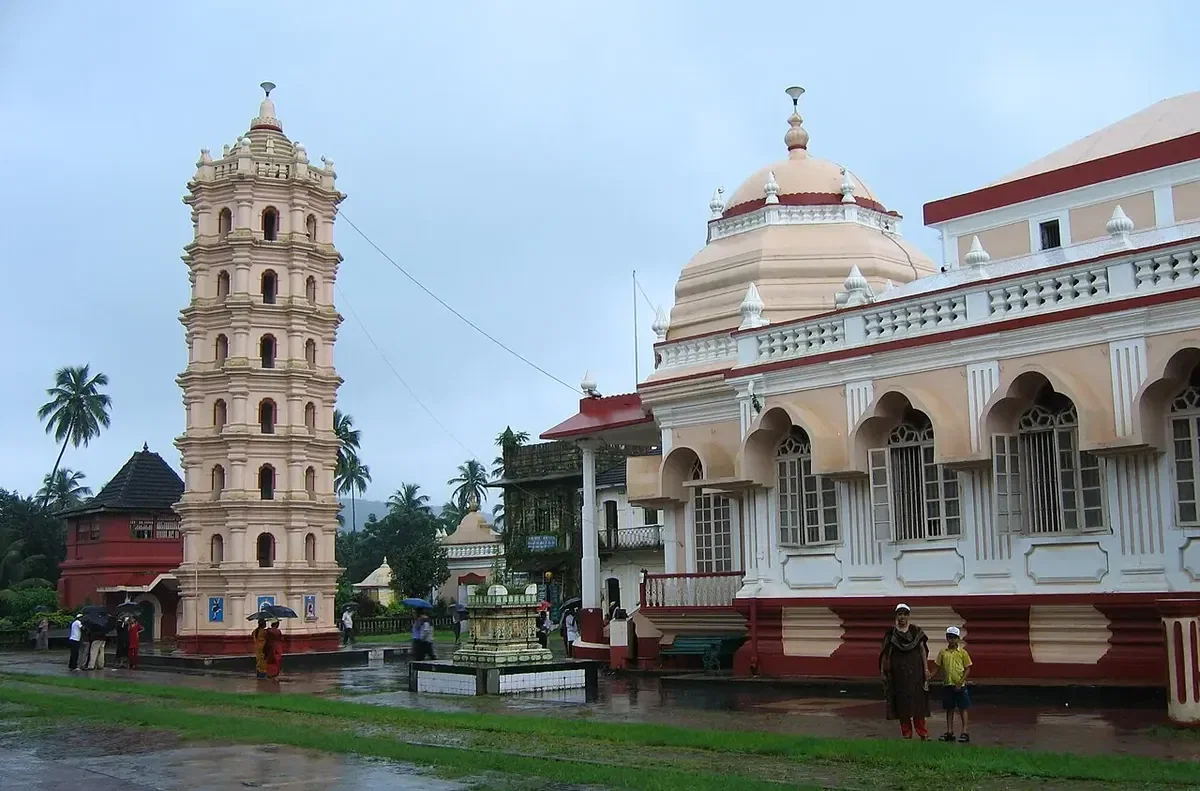
The temple at Priol grew through several rebuildings. A structure was raised during Maratha rule, a third building followed in 1890, and a fourth renovation ended on 17 February 1973 with a golden kalasha placed over the sanctum. The complex has domes, pilasters and balustrades, a large Nandi, a seven-storeyed deepastambha and an old water tank. The Sabha Mandapa holds over 500 people under nineteenth-century chandeliers and leads to the garbha griha where Shri Manguesh is enshrined.
Daily seva timings
Indicative — confirm on the temple's official site before visiting
Indicative — confirm on the temple's official site before visiting
Offerings & festivals
The main yearly festival, from Magha Shukla Saptami to the Magha full moon night.
The great night of Lord Shiva, celebrated at the temple.
Part of the temple's annual festival calendar.
Celebrated among the temple's annual festivals.
How to reach
The nearest airport is Dabolim, Goa.
The nearest major railway station is Madgaon (Margao), 26 km from the temple. Vasco da Gama is another option.
The temple is at Priol (Mangeshi), Ponda, 21 km from Panaji, 1 km from Mardol and 26 km from Margao. Buses run to Ponda town; take a taxi or auto from there.
-
Frequently asked questionsFAQs
Yes, general darshan at the temple is free.
More temples in GoaMore in Goa
View all →
Recommended Pujas
View all pujas →View allThis information is for awareness only. This temple is not a Vedamandir partner temple.