


Ambaji Mata Temple
Shakti Peetha of Maa Amba on the Arasur hills of Banaskantha, Gujarat, crowned by a 103-ft golden shikhara
Ambaji, Banaskantha, Gujarat

07:30–21:00 · Morning and evening aarti with darshan blocks
- General darshan
- Free
- Dress code
- There is no strict dress code, but modest and decent clothing is expected.
- Best season
- -
About the temple
Ambaji Mata Temple stands in the town of Ambaji in Gujarat's Banaskantha district. It sits 480 metres up on the Arasur ridge, at the southwestern end of the Aravalli range, and is honoured as one of the main Shakti Peethas. Devotees know the Goddess as Arasuri Ambaji, a name taken from the surrounding Arasur hills. There is no idol in the sanctum. Maa Amba is worshipped through a sacred yantra, dressed each day so that devotees see the form of an eight-armed Goddess on a lion. Gujarat Tourism credits Nagar Brahmins with building the original temple, and the temple's own site speaks of a legacy of more than 500 years. Today the Shree Arasuri Ambaji Mata Devasthan Trust looks after the shrine.
Significance
Ambaji is a Shakti Peetha linked with the heart of Sati. Worship here centres on the Visa Yantra, a sacred geometric plate ringed by seed syllables, one for each of the classical Shakti Peethas. The yantra stays hidden behind a curtain, and priests bathe it with their eyes blindfolded. For centuries the Goddess was the family deity of the Parmar Rajputs of Danta. Pilgrims walk hundreds of kilometres to her and carry red and gold flags, which are raised on the spire when a vow is fulfilled.
History
- 110th–13th century · On the pilgrim route
Under the Chaulukya rulers, the Arasur pass became part of regional trade and pilgrimage routes, and the area was known for its marble quarries.
- 214th century–1948 · Danta State patronage
The Parmar Rajputs of Danta served the shrine by hereditary right and worshipped Ambaji as their kuldevi.
- 3Post-1947 · Rebuilt in marble
The shrine was reconstructed in white marble to withstand the hill climate.
- 42010–2018 · Golden spire
The temple trust gilded the 103-ft shikhara with over 140 kg of donated gold and plated more than 350 kalash.
- 52020s · Shakti Corridor
State projects began linking the temple with Gabbar Hill and the Mansarovar tank and expanding pilgrim facilities.
Architecture
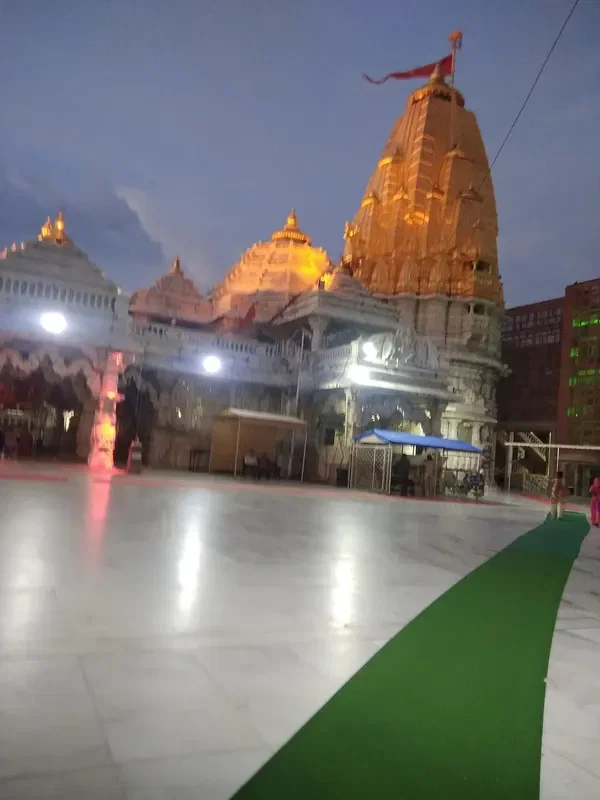
The temple follows the Māru-Gurjara style of Western India and rises from a raised plinth. A square, windowless sanctum holds the niche where the yantra is kept. In front of it is a domed assembly hall with carved marble pillars showing celestial dancers. Beyond that is an outer pillared pavilion where pilgrims queue. All around the shrine lies the Chachar Chowk, a wide courtyard of polished white marble used for havans, circumambulation and Garba. The 103-ft spire is covered in gold.
Daily seva timings
As published on the temple's official site
As published on the temple's official site
Offerings & festivals
A 5–7 day fair up to the Bhadrapada full moon, when lakhs of pilgrims arrive on foot.
Nine nights of Garba and Bhavai folk theatre in the Chachar Chowk.
How to reach
Ahmedabad (SVPI) airport is about 179 km away.
Abu Road station is about 20 km away, with taxis and autos to the temple.
About 65 km from Palanpur, 45 km from Mount Abu and 185 km from Ahmedabad. Taxis and buses run from Ahmedabad via Palanpur.
-
Frequently asked questionsFAQs
Yes. General darshan is free, and the wait is usually 30–40 minutes on normal days.
More temples in GujaratMore in Gujarat
View all →
Somnath Temple
Prabhas Patan, GujaratPrabhas Patan
Dwarkadhish Temple
Dwarka, GujaratDwarka
Nageshwar Jyotirlinga Temple
Dwarka, GujaratDwarka
Swaminarayan Akshardham, Gandhinagar
Gandhinagar, GujaratGandhinagar
Recommended Pujas
View all pujas →View allThis information is for awareness only. This temple is not a Vedamandir partner temple.