


Somnath Temple
First of the twelve Jyotirlingas, rebuilt in 1951 on the seashore at Prabhas Patan, Gujarat
Prabhas Patan, Gir Somnath, Gujarat

Darshan 06:00–22:00 · Aarti at 07:00, 12:00 and 19:00
- General Darshan
- Free
- Dress code
- Sarees, dhotis, pants, T-shirts and skirts are fine. Mini skirts and disrespectful clothing are not allowed. Mobiles, cameras and gadgets are prohibited; a free cloak room is available.
- Best season
- -
About the temple
Somnath Temple stands at Prabhas Patan, near Veraval, on the Saurashtra coast of Gujarat. Devotees honour it as the first of the twelve Jyotirlinga shrines of Lord Shiva. The site lies at a Triveni Sangam, where the Kapila, Hiran and Saraswati rivers meet near the Arabian Sea. Prabhas has been a place of pilgrimage since ancient times. It appears in texts such as the Mahabharata and the Bhagavata Purana, in Brahmi inscriptions and in the poems of Kalidasa. The temple was raided and rebuilt many times over the centuries. The present shrine was raised after Independence and consecrated in 1951. It is one of the most visited pilgrimage places in Gujarat. General darshan is free. The official temple website is somnath.org.
Significance
Somnath is the first of Shiva's twelve Jyotirlingas, where the Lord appeared as a column of fiery light. Temple tradition says that Soma, the Moon god, lost his glow because of a curse and bathed here in the Saraswati to win it back. This is linked to the waxing and waning of the moon. It also gives the town its name Prabhasa, meaning lustre, and the Lord his name Someshvara, lord of the moon. The temple was destroyed and rebuilt again and again. Its reconstruction in 1951 made it a symbol of national revival.
History
- 19th century · Someshvara in records
Gurjara-Pratihara king Nagabhata II recorded visiting Someshvara among the tirthas of Saurashtra.
- 21026 CE · Raid by Mahmud of Ghazni
Mahmud of Ghazni raided the temple and carried away its wealth.
- 31169 CE · Kumarapala's stone temple
Chaulukya king Kumarapala rebuilt the temple in stone, as an inscription records.
- 41299–1706 · Repeated destructions
The temple was sacked by Ulugh Khan (1299) and Zafar Khan (1395), and again on Aurangzeb's order (1706).
- 51782 · Ahilyabai Holkar's temple
Ahilyabai Holkar built a temple nearby, which kept worship going.
- 61947–1951 · Modern reconstruction
Sardar Patel resolved in November 1947 to rebuild the temple. President Rajendra Prasad consecrated it on 11 May 1951.
Architecture
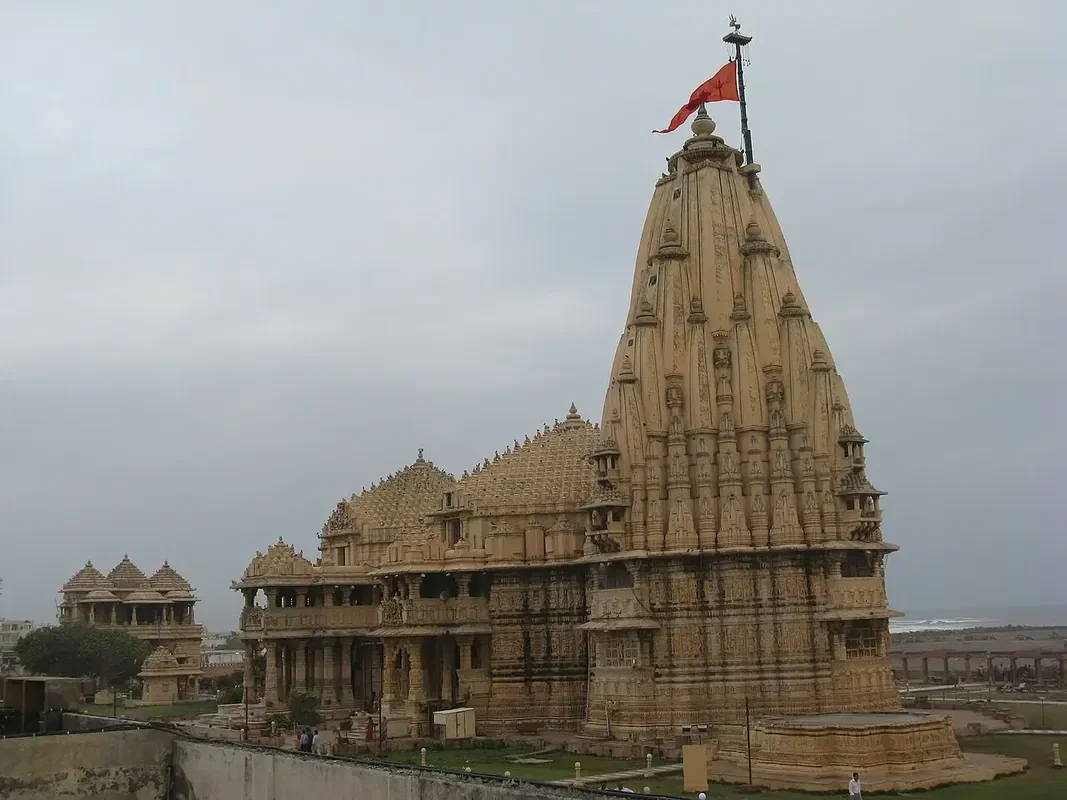
The present temple follows the Māru-Gurjara style of the Chaulukya (Solanki) tradition, in the Kailash Mahameru Prasad form. A 15 m shikhara rises over the sanctum and carries an 8.2 m flag pole. Excavations led by B.K. Thapar found the floor plan and remains of a finely carved temple from before 1000 CE. It faced east, and its sanctum was joined to entrance halls. A niche held a figure of Lakulisa, which shows it was a Shiva temple. Some pieces bear 10th-century script.
Daily seva timings
As published on the temple's official site
As published on the temple's official site
Offerings & festivals
The temple's major festival, the great night of Lord Shiva
A month of special observances for Lord Shiva
A five-day fair held at Kartik Purnima
Marks the consecration of the rebuilt temple on 11 May 1951
How to reach
Diu Airport is the nearest, about 85 km away. Rajkot (200 km) and Ahmedabad (390 km) also have airports.
Somnath railway station is close to the temple. Veraval Junction is 7 km away. Cabs and autos run from the station.
Roads connect the temple to Ahmedabad (about 400 km) and Diu (about 95 km). Cabs and auto-rickshaws are easy to find locally.
-
Frequently asked questionsFAQs
Yes. General darshan is free of cost. Paid pujas such as Bilva Pooja can be booked separately.
More temples in GujaratMore in Gujarat
View all →
Dwarkadhish Temple
Dwarka, GujaratDwarka
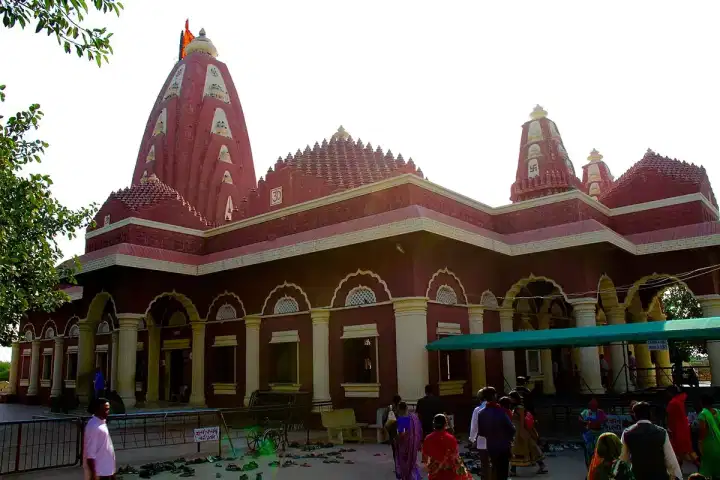
Nageshwar Jyotirlinga Temple
Dwarka, GujaratDwarka
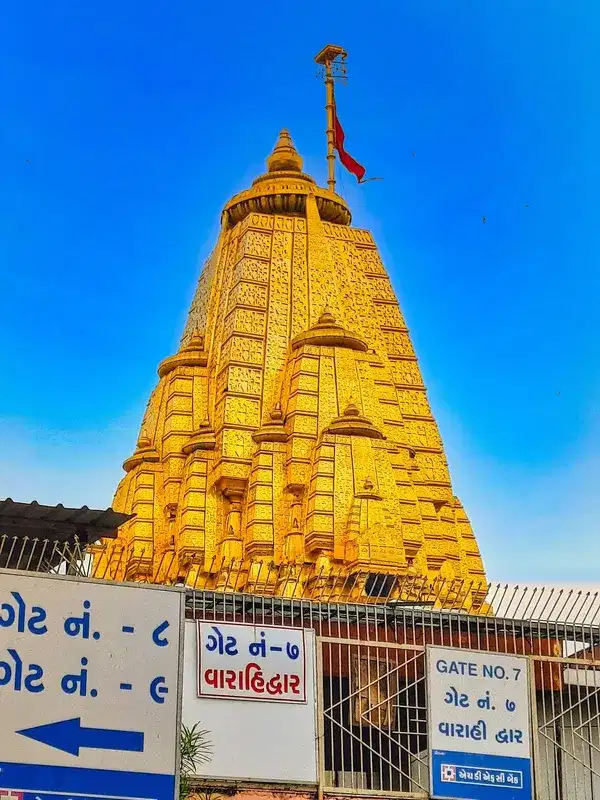
Ambaji Mata Temple
Ambaji, GujaratAmbaji
Swaminarayan Akshardham, Gandhinagar
Gandhinagar, GujaratGandhinagar
Recommended Pujas
View all pujas →View allThis information is for awareness only. This temple is not a Vedamandir partner temple.