


Kamakhya Temple
An ancient seat of the Mother Goddess on Nilachal Hill, Guwahati, revered as a Shakti Peeth and centre of Tantra
Guwahati, Kamrup Metropolitan, Assam

Darshan 08:00 to 17:15 · Closed 13:00–14:30 for bhog
- General queue
- Free
- Special Darshan
- ₹501
- Dress code
- No strict dress code, but modest clothing covering shoulders and knees is expected. Remove footwear before the main shrine complex; free shoe-keeping counters are available.
- Best season
- -
About the temple
Kamakhya Temple stands on Nilachal Hill in Guwahati, Assam, and is dedicated to the mother goddess Kamakhya. It counts among the four oldest of the 51 Shakti Peeths and is one of India's most important centres of Tantric worship, at the heart of the Kulachara Tantra Marga. The goddess's roots go deep into the region's tribal traditions, and her worship is older than the kingdom of Kamarupa. The present temple took shape over many centuries of rebuilding, giving rise to its own local style, known as Nilachal. For long a little-known shrine, it grew into a major pilgrimage destination in the 19th century, especially for devotees from Bengal. Today thousands gather here every June for the Ambubachi Mela.
Significance
Kamakhya is honoured as one of the oldest Shakti Peeths, where the Mother Goddess is worshipped as the source of creation. It is a leading seat of Tantric practice in India. The Ambubachi Mela, held each year to mark the goddess's menstruation, is seen as a time of great spiritual power. The temple shuts for about three days and reopens to huge crowds of pilgrims and tantra devotees. Durga Puja during autumn Navaratri is also a major occasion here.
History
- 19th century · First inscription to the goddess
Tezpur plates of the Mlechchha dynasty name Kamakhya; this dynasty built or rebuilt the early temple.
- 21498 · Temple destroyed
The old temple fell during Hussein Shah's invasion of the Kamata kingdom.
- 31515–1540 · Worship revived
Vishwasingha, founder of the Koch dynasty, found the ruins and restarted worship at the site.
- 41565 · Koch reconstruction
Under King Nara Narayan, the temple was rebuilt under Chilarai's supervision, reusing stones from the old shrine.
- 5After 1681 · Ahom control
After the Battle of Itakhuli, the Ahoms held the temple without break and added to the Koch structure.
- 619th century · Major pilgrimage
Kamakhya became an important pilgrimage destination, especially for devotees from Bengal.
Architecture
The temple's base and plinth mouldings show that the first shrine was in the Nagara style. When it was rebuilt in 1565, two attempts to restore a stone shikhara failed, so the Koch artisan Meghamukdam turned to brick. The result was a rounded, hemispherical dome ringed by small tower-like angashikharas, shaped by builders familiar with Bengal's architecture. This new form became the Nilachal style, later popular with the Ahoms. A carving of Lajja Gauri sits on the north wall of the Natmandira.
Daily seva timings
As published on the temple's official site
As published on the temple's official site
Offerings & festivals
Marks the goddess's yearly menstruation; temple closes about three days, drawing thousands of devotees
Five-day celebration during autumn Navaratri that draws several thousand visitors
An annual celebration at the temple
How to reach
Nearest airport: Lokpriya Gopinath Bordoloi International Airport, Guwahati.
Nearest railway station: Guwahati Junction.
Shared cabs and autos run from Guwahati railway station and Paltan Bazar up to the temple on Nilachal Hill.
-
Frequently asked questionsFAQs
Yes. The general queue is free. A Special Darshan costs ₹501, but it is not offered on the days the temple reopens after Ambubachi Mela.
More temples in AssamMore in Assam
View all →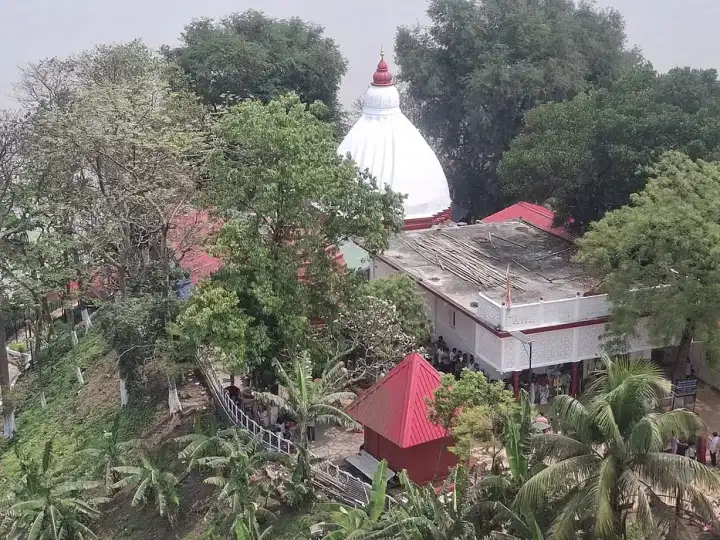
Recommended Pujas
View all pujas →View allThis information is for awareness only. This temple is not a Vedamandir partner temple.