


Vishnupad Temple, Gaya
Lord Vishnu's sacred footprint on the banks of the Phalgu, where families offer Pind Daan for their departed
Gaya, Gaya, Bihar

-
- General Darshan
- Free
- Dress code
- Wear traditional, modest clothing that covers shoulders and knees, such as a dhoti or kurta for men and a saree or salwar kameez for women.
- Best season
- -
About the temple
Vishnupad Temple stands on the banks of the Phalgu river in Gaya, Bihar, and is dedicated to Lord Vishnu. At its heart is a footprint about 40 cm long, cut into a block of basalt called the Dharmasila and set within a silver-plated basin. Devotees honour it as the mark Vishnu left when he pressed the demon Gayasura beneath the earth. The temple is the main centre in Gaya for Pind Daan and other Shraddha rites for departed ancestors. These rites have long been led by Gayawal Brahmin priests. The present stone temple was rebuilt in 1787 by Devi Ahilya Bai Holkar, ruler of Indore. Within the complex grows the Akshayavat banyan, where final rites for the dead are performed. Many small shrines surround the main temple.
Significance
Devotees believe Gayasura won a boon that anyone who saw him would gain moksha. Lord Vishnu then placed his right foot on the demon and sent him beneath the earth. The footprint that remained bears nine symbols, including the conch, discus and mace. Gayasura asked for food, and Vishnu promised that someone would feed him every day, and that those who did so would help their departed reach heaven. Families from across India come here to offer food and prayers for their ancestors. This makes Gaya the foremost place for Pind Daan and Shraddha.
History
- 1Ancient tradition · Visit of Rama and Sita
Tradition holds that Lord Rama and Sita came to this sacred spot.
- 2Medieval period · Visits by great saints
Madhvacharya, Chaitanya Mahaprabhu and Vallabhacharya are recorded among its visitors.
- 31787 · Rebuilt by Ahilya Bai Holkar
The ruler of Indore rebuilt the temple in stone, carved by Rajasthani craftsmen at Patharkatti.
- 4January 2024 · Declared a public religious trust
The Patna High Court ruled the temple a public trust under the Bihar Hindu Religious Trust Act, 1950.
Architecture
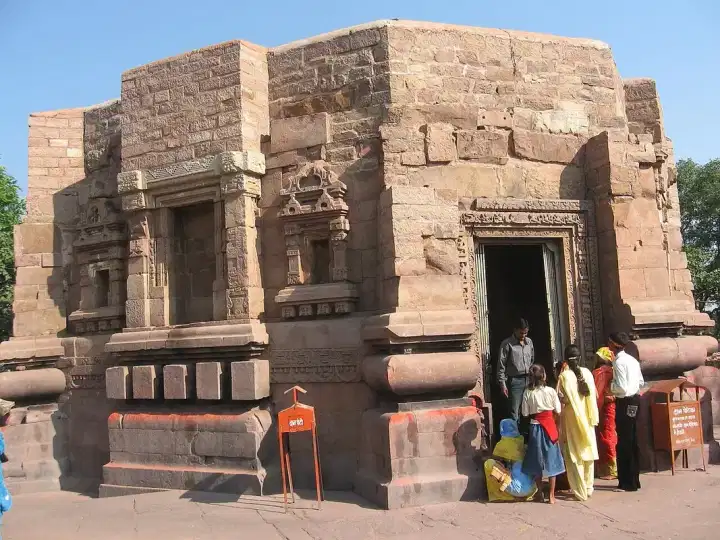
The temple is built of large grey granite blocks held together with iron clamps. Its octagonal shrine faces east and rises to a pyramidal tower about 30 metres high, crowned with a gold flag. The tower's sloping sides alternate between indented and plain sections, set at angles to form a cluster of peaks meeting at the top. Eight rows of carved pillars hold up the pavilion. The sanctum holds Vishnu's footprint in solid rock, set within a silver-plated basin.
Daily seva timings
-
-
Offerings & festivals
The temple's biggest event: a fortnight when families gather to perform rites for their ancestors.
How to reach
Gaya Airport is the nearest airport, about 8 km from the temple.
Gaya Junction railway station is about 4 km away.
The temple is on the bank of the Phalgu river in Gaya town. Auto-rickshaws and cycle-rickshaws run within the city.
-
Frequently asked questionsFAQs
Yes, general darshan is free.
More temples in BiharMore in Bihar
View all →
Recommended Pujas
View all pujas →View allThis information is for awareness only. This temple is not a Vedamandir partner temple.